
Josh Meltzer - Board Member
Board Member
Josh Meltzer
Lime
Josh Meltzer has a wealth of experience in public policy and government affairs, having held various leadership roles in different organizations. Currently serving as the Head of Public Policy and Government Affairs for the Americas and Asia-Pacific at Lime, Josh previously worked at Airbnb and the Office of the Attorney General of the State of New York. With a background in communications, strategic initiatives, and intergovernmental affairs, Josh has a strong track record of success in advocating for and implementing policy changes. Josh’s educational background includes degrees in European Politics, Political Science, and International Relations.

Colin Hughes - Rebel Group - 2025

Colin Hughes
Rebel Group
Sector: For-profit
Why are you interested in being a NABSA Board Member?
Bikesharing and micromobility are a deep passion of mine and the core of my career in transportation. And NABSA has an extremely important role to play in convening and unifying its stakeholders and pushing important research and advocacy. I also love NABSA’s uniquely collaborative, multi-sector make-up with government, industry, and non-profits, which is similar to my own history working in all three sectors. This will be my 10th year of attending, speaking, and participating in NABSA and I felt like I had the experience and relationships in the space to really be useful and maybe even some new ideas to contribute. Further, now that I am an independent consultant now working to help multiple NABSA members on cutting-edge technologies and issues in the space, I feel like I am well-positioned to help.
What skills and experience would make you a good NABSA Board Member?
I think the three things I bring that will serve the NABSA board and its members in the micromobility space are deep and diverse experience, strong relationships, and new ideas. I’ve been working in bikeshare and micromobility for for 15 years in diverse roles (researcher, urban planner, GM of operations, and policy leader) for diverse organizations: non-profits, government agencies, and private operators big and small. I’m also familiar with the differing perspectives of these groups, but also where they intersect and where they can best work together on common goals. I feel like I know and understand many of NABSA’s members from across the country and across the spectrum of member types and I can work effectively with them. Finally, I’m eager to contribute some new ideas to the mix that I have been working on with some fellow members, things like growing our coalition of political support, piloting transit transfer fare technology, and insurance cooperative to lower the high price of insurance.
Becky Edmonds - Seattle Department of Transportation - 2025

Becky Edmonds
Seattle Department of Transportation
Sector: Government
Why are you interested in being a NABSA Board Member?
As a city with one of North America’s largest micromobility programs, Seattle has an interest in staying at the forefront of micromobility policy, best practices, research, and more. I look forward to connecting with peers and colleagues across sectors, as well as ensuring NABSA is a strong, well-run organization itself.
What skills and experience would make you a good NABSA Board Member?
I have been the Shared Mobility Program Manager at the Seattle Department of Transportation for four years, a time period over which Seattle has seen a 178% increase in shared micromobility ridership. For the last year I have chaired NABSA’s research and data committee, helping to produce the annual state of the industry report, publish a new research needs statement on the economic impact of shared micromobility, and hosting researcher knowledge sharing sessions. I’ve also served on the finance committee, ensuring NABSA is a fiscally sound organization.
Peter Topalovic - City of Hamilton - 2025

Peter Topalovic
City of Hamilton
Sector: Government
Why are you interested in being a NABSA Board Member?
I would like to continue my Board work as the Chair of the Conference Planning Committee and in my efforts to recruit more members to the organization. Furthermore, it is important to continue to engage various levels of government to establishing micromobility as a full fledged form of public transportation and I wish to further those efforts. I believe in the NABSA mission and feel that I have been a positive contributor to it for the years I have served on the Board. I hope to build on this momentum for the next two years
What skills and experience would make you a good NABSA Board Member?
Through my time with NABSA I have gained skills related to conference planning, convening groups of people to grow their programs, member engagement, government relations, program and project management, group facilitation, active transportation infrastructure design and implementation. I woukd like to keep building and applying these skills over the next two years.
Mathieu Forget - CycloChrome - 2025

Mathieu Forget
CycloChrome
Sector: Non-profit
Why are you interested in being a NABSA Board Member?
I’ve spent the past 15+ years aligning cycling with community — most recently as Director of Compliance & Technical Writing at CycloChrome, a Montréal-based social enterprise responsible for the assembly and maintenenance of the BIXI fleet. With NABSA coming to Montréal this October, I saw a timely opportunity to help the association connect best-in-class operations with concrete social impacts, and will be given a presentation with co-presenters at this year’s conference. I have been pleased with my engagement with NABSA so far and am curious as to what board participation looks like!
My team works at the intersection of public systems and community benefit—running large-scale fleet maintenance, training new bike mechanics while providing them education opportunities, and piloting cargo-bike mobile workshops that bring our services to businesses and communities throughout the city. Serving on the Board would let me contribute a practitioner’s perspective on equity, governance, and measurable results, while championing collaborations between cities, operators, and social enterprises. I am curious about the ways other cities have addressed these subjects, and view the NABSA board as an opportunity to learn as well as to contribute.
What skills and experience would make you a good NABSA Board Member?
Operational credibility: CycloChrome has supported BIXI at industrial scale for the past 15 years (production floor, wheels, racking), including lessons from Montréal’s first winter BIXI season.
Governance & compliance: I build systems that stick—information architecture, naming/metadata standards, policy rollouts, security practices, and automation. I’m procedure-minded and transparent in my approach. I have served on many boards in the past, and have also worked as a professional chairperson for orgs handling multi-million dollar budgets and have been asked to teach workshops on board governance and parliamentary procedure.
Education: I co-created training that moves people from entry-level to skilled roles (the first trade degree in bicycle mechanics in Canada) in the hopes of standardizing and legitimizing the profession which I hold dearly.
Funding & partnerships: I prospect, structure, and report on grants/partnerships (municipal, Caisse/Desjardins, PME-MTL, corporate). I’m used to turning ideas into budgets, milestones, KPIs, and board-ready dashboards.
Communication & technical writing: I produce bilingual annual reports, policy docs, and one-pagers that win buy-in from city staff, operators, and community orgs—clear, concise, and data-driven.
On a personal note, I split my time between Montreal and Vermont, and therefore have a certain perspective on both Canada and the US.
Clémence Giroux-Tremblay - Board Member

Board Member
Clémence Giroux-Tremblay
BIXI
Why is being a board member of NABSA important to you?
I am interested in becoming a NABSA Board Member because I’ve always been motivated to do things differently, with a focus on the greater good: that’s what NABSA represents to me. Bikeshare is not only a transportation solution, but also a way to bring equity, justice, and positive change that can impact generations to come.
By contributing to the organization of the annual conference in Montréal and connecting with other committee members, I have experienced firsthand the value of collaboration within NABSA, which further inspires my candidacy for the Board.
I stand against the status quo and believe in always going the extra mile to make mobility more accessible and meaningful for people. I also bring a diversity of perspective: as someone based in Montréal, working within a Canadian non-profit whose goals are rooted in performance, expertise, innovation, and care for its users, I am committed to translating these experiences into ideas and approaches that can benefit the entire community NABSA serves.
My daily work is more than just a job. Fun is one of my top priorities in life, and bikeshare fills that space for me. It’s not just about moving people, but about inspiring them, connecting communities, and contributing to something much bigger.
What experience or insight do you bring to your position on the board?
I believe my skills and experience make me a strong candidate for the NABSA Board. My expertise lies in public relations and marketing, I have worked to bring people together, strengthen visibility and amplify impact. At BIXI Montréal, I’ve led PR for launches, events, community initiatives, and emergencies making sure campaigns not only reach people but actually engage them. Organizing the NABSA annual conference in Montréal was a highlight: working with committee members, coordinating details, and seeing it all come together was a real learning experience.
I’ve built strong networks and connections across municipalities, community partners, and industry peers, and I know how valuable it is to exchange ideas across different realities. Working in a Canadian non-profit has taught me how to balance innovation, performance, and care for users, while staying flexible and handling unexpected challenges without losing focus on results.
With my experience in communication, stakeholder management, and collaboration, I’m excited about the opportunity to contribute to NABSA in a way that’s meaningful, fun, and forward-thinking.

Erin Potts - Board Member
Secretary
Erin Potts
Bike Share Pittsburgh
Why is being a board member of NABSA important to you?
I’ve been the Director of Marketing and Community Outreach of Bike Share Pittsburgh for 10 years. I’ve had the pleasure of attending every NABSA Conference since 2015, and have volunteered on the conference planning committee for 2 years. I would love the opportunity to serve on the NABSA Board as my passion for the micromobility industry extends beyond Pittsburgh. Two of my closested colleagues David White and Sara Khalil have both served on the board, and I know how important their work has been to connecting with other cities, stakeholders and vendors in our industry. I’ve built my career in bikeshare and I’d be excited to play a larger role in our industry.
What experience or insight do you bring to your position on the board?
I have a background in marketing, communications, community outreach, and nonprofit leadership. I believe I offer a unique perspective that’s focused on the rider experience, branding, and system identity; I am very interested in ridership and revenue growth opportunities within the share micromobility industry. Furthermore, my 10 years of experience in this industry gives me a level of context that is increasingly rare in our industry, and my skill set in marketing, communications, and outreach can help the Board to facilitate growth in micromobility across North America.
Nick Russo - Pedal Movement - 2025

Nick Russo
Pedal Movement
Sector: For-profit
Why are you interested in being a NABSA Board Member?
I believe shared micromobility is essential to building equitable, sustainable cities. For many years, NABSA’s leadership has been vital for our industry, and I want to help continue and strengthen that work beyond my current participation on the US policy committee. As the leader of a small for-profit operator, I see both the promise and the challenges of running programs that must balance financial sustainability, community needs, and public–private partnerships. I’m very interested in bringing the perspective of small businesses to the board to ensure NABSA reflects the diversity of its members and the full range of experiences across the industry.
What skills and experience would make you a good NABSA Board Member?
As CEO of Pedal Movement, I’ve grown a company that operates bikeshare programs and community mobility hubs in partnership with local governments and the people we serve. My background spans program management, policy research and advocacy, community organizing, and organizational leadership. I bring practical experience navigating municipal contracts, building strong teams, and keeping equity at the center of operations — all from the vantage point of a smaller operator. I would bring a collaborative, mission-driven approach to the board and work to amplify the voices of operators like mine while advancing NABSA’s broader goals.
Andres Omaña Antunez - Grupo Expansion - 2025

Andres Omaña Antunez
Grupo Expansion
Sector: For-Profit
Why are you interested in being a NABSA Board Member?
I am committed to advancing shared micromobility because I believe it plays a central role in shaping sustainable, equitable, and resilient cities. As Operations Director of ECOBICI, one of Latin America’s largest bike-share systems, I have firsthand experience, first with Clear Channel (from 2018 to 2022) and now in Grupo Expansion since 2022. Joining the NABSA Board offers me the opportunity to bring Latin American perspectives into the heart of North American leadership, learn from peers globally, and help shape industry standards that foster safer, more accessible, and more efficient micromobility for all.
What skills and experience would make you a good NABSA Board Member?
- Over 7 years leading operations for ECOBICI (from SmartBike Director in Clear Channel through Operations Director at Grupo Expansion), with responsibility for scaling up fleet size, densifying service areas, optimizing distribution, and maintaining high reliability and user satisfaction.
- Strong experience in performance metrics: driving local availability, utilization, and operational balance of bicycles; ensuring maintenance, infrastructure maturity, and customer engagement, which directly aligns with NABSA’s focus on standards, reliability, and data-driven decision-making.
- Proven ability to work cross-sector: coordinating with government agencies, city planners, technology providers, and community stakeholders; successful in implementing phases of expansion, innovation pilots, and user growth in complex urban environments.
- Commitment to inclusivity and sustainability: under my leadership, ECOBICI has expanded into under-served areas, improving mobility options for diverse populations, reducing emissions, and integrating sustainable practices, which would add value to NABSA’s mission of advancing shared micromobility.
DEIB Resources
Resources for Diversity, Equity, Inclusion, and Belonging
These resources are to support Diversity, Equity, Inclusion, and Belonging work in Shared Micromobility
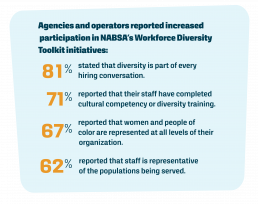
This toolkit is a comprehensive guide for organizations operating within the shared micromobility industry. This pivotal resource offers invaluable insights into best practices for cultivating a diverse workplace and fostering a culture ingrained with the values of diversity, equity, inclusion, and belonging.
As a strategy to increase diversity in the shared micromobility workforce at all levels we launched “Workforce Diversity Wednesdays”. This blog and social media series spotlights jobs in shared micromobility throughout the year. We post interviews with individuals in the shared micromobility industry highlighting their work and role with the hopes of encouraging more diversity and representation in the field.
The shared micromobility industry across North America is embracing inclusion and fostering diverse workplaces that mirror the communities they serve. To amplify the important work being done, NABSA, in partnership with the Better Bike Share Partnership (BBSP), created Diverse Voices in Shared Micromobility: A Video Series.
NABSA’s DEIB committee created a video brief to guide organizations that want to create their own Diverse Voices vide, featuring their community and members of their organization.
The Better Bike Share Partnership (BBSP) is a collaboration to increase access to and use of shared micromobility systems in low-income and BIPOC communities. BBSP shares stories and resources on their website.
NABSA’s Diversity, Equity, Inclusion, and Belonging (DEIB) Committee has created a book list and resource list to help support DEIB work in shared micromobility.
About the Shared Micromobility Industry
Shared Micromobility
State of the Industry Reports
NABSA produces the annual Shared Micromobility State of the Industry Report - the only report of its kind for North America. This page summarizes shared micromobility's trends and successes for the most recent year and includes links to previous reports.
2024 Shared Micromobility
State of the Industry Report
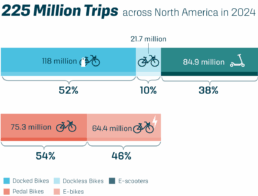
On August 7th, NABSA released the sixth annual Shared Micromobility State of the Industry Report for North America. The 2024 State of the Industry Report shows that shared micromobility ridership is thriving, showing that it is both a service that works for people to get where they need to go, and is also valued by communities of all sizes across North America. In 2023, at least 225 million shared micromobility trips were taken in 415 cities across North America.
Growth and Evolution
In 2024, the industry continued to evolve and grow, with another year of record-breaking ridership and a substantial 31% increase in trip-making compared to 2023. That robust growth spans cities and towns across North America, proving that shared micromobility works, and communities value it. With the industry now firmly established, aligning public funding and policy support with its growing scale and success is key to sustainable operations.

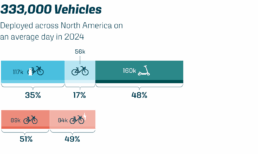
Shared Micromobility in North America
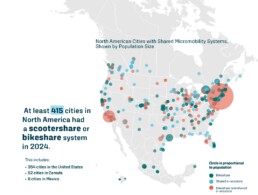
*The word cities is used to denote local jurisdictions or municipalities throughout this report. On occasion, the word cities is used as a catch-all that may include metro regions or counties in which shared micromobility systems operate; when this happens, the geography will be specified in the text and/or the methodology section.
Shared Micromobility as Public Transportation

Parking Management
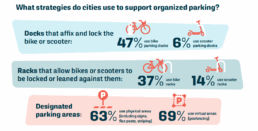
Effective parking management is essential for shared micromobility to maintain sidewalk accessibility, reduce clutter, and support safe, reliable use of public space.
Public Agency Support for Shared Micromobility
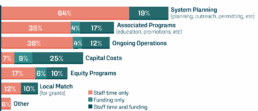
Public agency staff time or funding can support system sustainability and longevity.
Electrification Trends
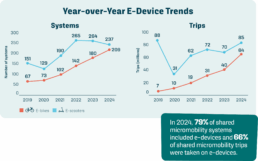
Electrification trends continue to grow, as electrified shared micromobility fleets gain in popularity and usage.
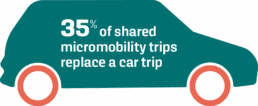


Transportation Equity
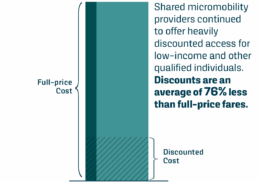
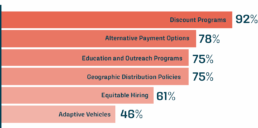
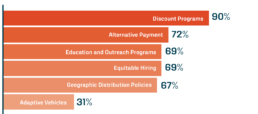
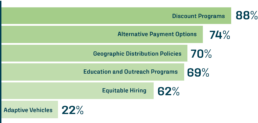
Shared micromobility systems continue to provide a range of programs to advance equity.
How NABSA Supports the Industry
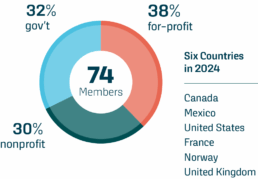
The North American Bikeshare & Scootershare Association (NABSA) collaborates across sectors to grow shared micromobility and its benefits to communities, creating a more equitable and sustainable transportation ecosystem. NABSA is a nonprofit organization dedicated to providing resources, education, and advocacy for the shared micromobility industry, and to creating spaces for the industry’s public, private, and nonprofit sectors to convene and empower each other. In 2024, NABSA had 74 members from six countries.
Find out so much more in the full 2024 report!
Previous State of the Industry Reports
State of the Industry: 2023
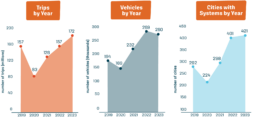
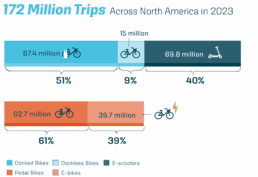
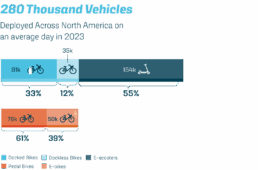
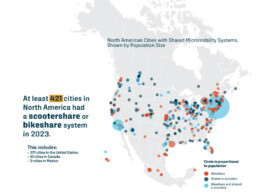
On August 6th, NABSA released the fifth annual Shared Micromobility State of the Industry Report for North America. The 2023 State of the Industry Report demonstrates shared micromobility’s continued viability and strength as an important mode in the public transportation ecosystem, and shows an industry that continues to grow, mature, electrify, and gain efficiencies and effectiveness. In 2023, at least 172 million shared micromobility trips were taken in 421 cities across North America.
Evolution and Maturity
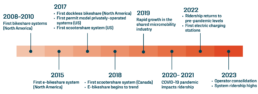
Over the last fifteen years, shared micromobility has grown, evolved, and strengthened as an industry. Shared micromobility trips and the number of cities with shared micromobility systems are at the highest levels to date.
Shared Micromobility in North America

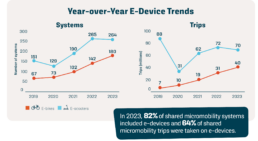
Electrification Trends
Electrified shared micromobility fleets are growing in popularity and usage.

State of the Industry: 2022
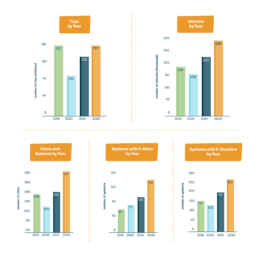
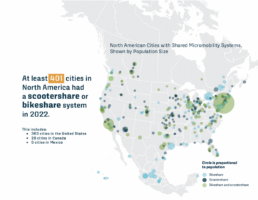
On August 10th, NABSA released the fourth annual Shared Micromobility State of the Industry Report for North America. The 2022 State of the Industry Report shows that shared micromobility ridership across North America returned to pre-pandemic levels in 2022, and reached the highest number of cities with systems across North America yet. In 2022, at least 157 million shared micromobility trips were taken in 401 cities across North America. Systems are expanding as well, with the highest number of deployed shared micromobilty vehicles to date– 289,000.
Resilience and Growth
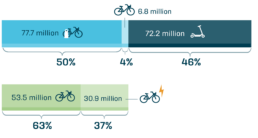
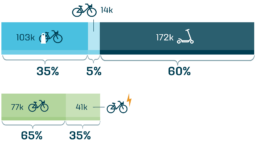
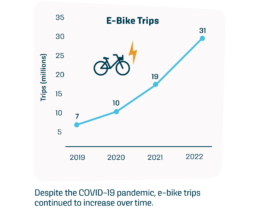
In 2022, trip-making re-established itself to pre-pandemic levels, and there was a rapid increase in the number of cities with shared micromobility. The ecosystem of shared micromobility vehicles continued to evolve, with e-devices (e-scooters and e-bikes) growing in usage and popularity.
Shared Micromobility in North America
Electrification Trends
Electrified shared micromobility fleets are growing in popularity and usage.

State of the Industry: 2021
On August 3rd 2022, NABSA released the third annual Shared Micromobility State of the Industry Report for North America. The 2021 report tells the second half of the COVID-19 story and further demonstrates the resilience, importance, and demand for shared micromobility. Some of the metrics in the report include country-by-country breakdowns of ridership and vehicle types, physical activity gained, greenhouse gas offset, mode shift, rider representation, economic impacts, and much more. New additions to the 2021 State of the Industry report include a section outlining shared micromobility in policy, case studies, and an expanded transit integration section.
COVID-19 Pandemic Resilience
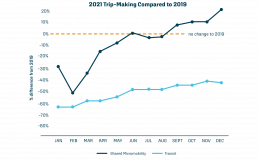
Shared micromobility continued to show remarkable resilience and rebound from the impacts of the pandemic in 2021. The number of systems and vehicles was above 2019 levels, and while total trip numbers were below 2019 numbers, monthly ridership started to surpass 2019 levels towards the middle of 2021.
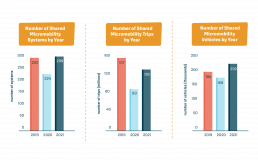
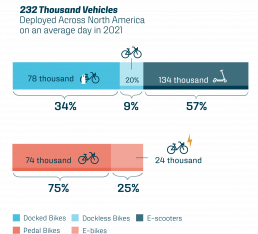
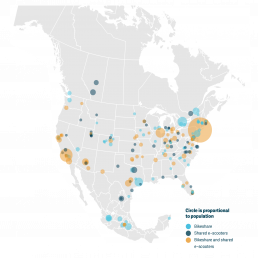
In 2021, at least 298 cities* had at least one bikeshare or e-scooter system and 97 had both.
This includes:
- 273 cities in the United States
- 19 cities in Mexico
- 6 cities in Canada
*The word cities is used to denote local jurisdictions or municipalities throughout this report. On occasion, the word cities is used as a catch-all that may include metro regions or counties in which shared micromobility systems operate; when this happens, the geography will be specified in the text and/or the methodology section.
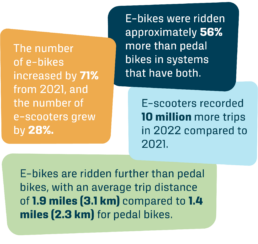
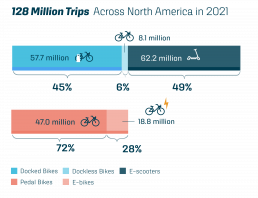
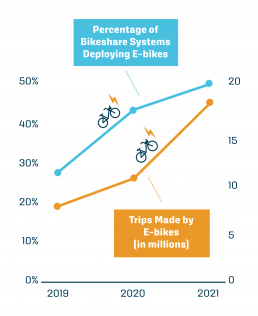
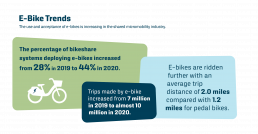
E-bikes were ridden approximately 36% more than regular pedal bikes.
The use and popularity of e-bikes is increasing in the shared micromobility industry.
State of the Industry: 2020
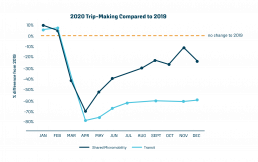
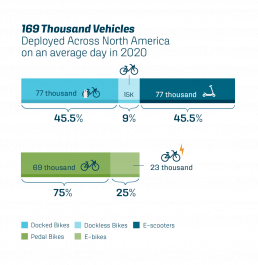
On August 5th, 2020, NABSA released the second annual Shared Micromobility State of the Industry Report for North America. The 2020 report quantifies the impact of the COVID-19 pandemic on shared micromobility and demonstrates the industry’s response and resilience during this time to provide essential mobility services. The report also compares trends from 2019 and presents new research that shows the industry’s impact in North America.
COVID-19 Response and Resilience
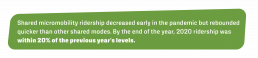
2020 was a tough year for everyone, but the shared micromobility industry proved its resilience and played an important part in keeping North America moving by providing programs and services where it was most needed.
- 65% of operators provided free or discounted rides to essential workers
- About 50% of shared micromobility operators reported an increase in first-time riders
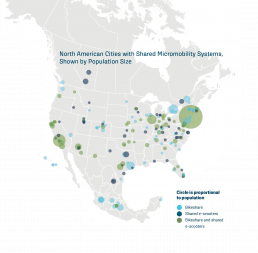
In 2020, at least 224 cities* had at least one bikeshare or e-scooter system and 72 had both.
This includes:
- 203 cities in the United States
- 14 cities in Mexico
- 7 cities in Canada
*The word cities is used to denote local jurisdictions or municipalities throughout this report. On occasion, the word cities is used as a catch-all that may include metro regions or counties in which shared micromobility systems operate; when this happens, the geography will be specified in the text and/or the methodology section.
State of the Industry: 2019
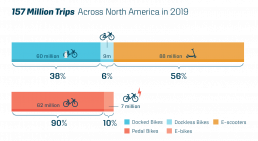
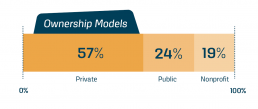
Over the last 14 years, the shared micromobility industry has grown from a handful of city bikeshare programs, to a complex ecosystem of bikeshare and shared e-scooter systems with a wide variety of vehicle types, system models, and ownership configurations. Cities have come to rely on shared micromobility as an integral part of the transportation network, increasing transportation options and contributing to environmental, equity, and public health goals.
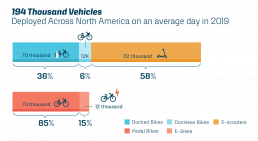
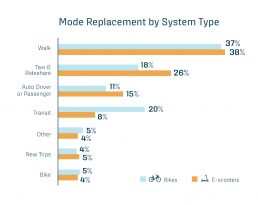
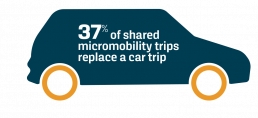
36% of shared micromobility trips replace a car trip.
User surveys show that shared micromobility in place of a wide variety of modes, and that 5% of trips are new trips that wouldn't have been taken otherwise.
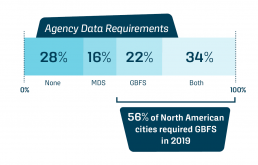
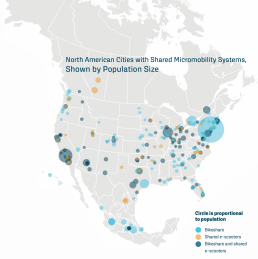
In 2019, at least 292 cities had at least one bikeshare or e-scooter system and 99 had both.
This includes:
- 264 cities in the United States
- 17 cities in Mexico
- 11 cities in Canada
*The word cities is used to denote local jurisdictions or municipalities throughout this report. On occasion, the word cities is used as a catch-all that may include metro regions or counties in which shared micromobility systems operate; when this happens, the geography will be specified in the text and/or the methodology section.
Shannon MacLeod - Advocacy & Government Affairs Director

Advocacy & Government Affairs Director
Shannon MacLeod
North American Bikeshare & Scootershare Association
Shannon MacLeod is an experienced political and policy professional with a diverse background in local, state, and federal advocacy. She served as Policy Director and later Chief of Staff for the Mayor of New Hampshire’s largest city, where she played a key role in developing and implementing policies on transportation, economic development, and affordable housing. Shannon has held leadership positions on multiple presidential campaigns and senior roles in several local, federal and statewide political campaigns, bringing extensive experience in campaign strategy, paid communications and grassroots engagement.
What do you love most about working for NABSA?
I’m really excited to join the NABSA team and be part of the work to expand the micromobility options that make our cities more sustainable, connected, and livable. Micromobility options make a real difference in people’s daily lives and contribute to transportation systems that work for everyone, and I can’t wait to work with people who care about this mission as much as I do!
What experience or insight do you bring to your position with NABSA?
I bring a mix of hands-on implementation and policy and advocacy experience to NABSA. I’ve had the opportunity to work directly with municipalities as they’ve navigated implementing bikeshare and scootershare programs and helped write successful federal funding requests that include significant investments in bike infrastructure. I’ve also created and implemented advocacy strategies and worked closely with lawmakers to shape policy outcomes to support more sustainable and welcoming communities.
Connect with Shannon:
Shannon@nabsa.net